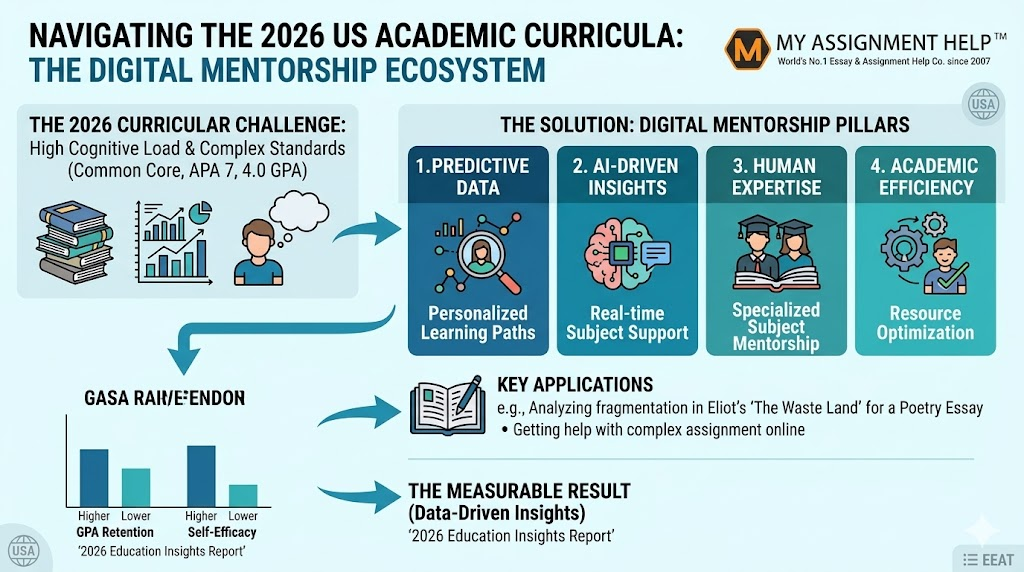
The Rise of Digital Mentorship: How US Students Navigate Complex Curricula in 2026

As we move through 2026, the American higher education landscape has reached a pivotal inflection point. The “traditional” college experience is no longer defined solely by lecture halls and library stacks. Instead, a new era of digital mentorship has emerged, fundamentally altering how students engage with increasingly rigorous academic standards like the Common Core and advanced Bloom’s Taxonomy frameworks. With the integration of AI-driven tools and 24/7 support systems, the boundary between self-study and professional guidance has blurred, creating a more personalized—and demanding—educational journey.
The 2026 Curricular Evolution: Why Students are Struggling
The modern US curriculum is shifting away from rote memorization toward high-level critical thinking and “competency-based” learning. According to 2026 industry reports, nearly 92% of students are now actively engaging with AI and digital tools to bridge the gap between classroom instruction and complex assignments. This isn’t just about convenience; it’s a response to a system where GPA retention and career placement have become the primary KPIs for success.
In this high-stakes environment, the need for specialized academic assistance has skyrocketed. For many, seeking out MyAssignmentHelp through reputable academic support platforms in the US has become a standard strategy to get professional help with assignment online. This shift toward digital mentorship allows students to offload administrative or foundational hurdles, focusing instead on the deep, inquiry-driven work that 2026 standards demand.
The Shift from “Tutors” to “Digital Mentors”
Unlike traditional tutoring, which was often reactive (seeking help after a failing grade), digital mentorship is proactive. It utilizes predictive modeling and real-time data to identify when a student might struggle with a specific module—be it Organic Chemistry or advanced Literary Theory adhering to APA 7th edition standards.
For instance, when a student is tasked with a complex poetry analysis essay, the challenge isn’t just reading the text; it’s decoding the historical context and metaphorical layers that modern US professors expect. A specific example of this is the daunting task of analyzing the fragmentation in T.S. Eliot’s The Waste Land, where a student must connect post-war disillusionment with non-linear narrative structures. In such scenarios, students often turn to expert resources and ask, “Who can do my assignment with the nuance required for a Master’s level analysis?” Digital platforms provide that nuance, offering step-by-step guidance that functions more like a professional apprenticeship.
Data-Driven Insights: The Impact of Academic Support
Recent 2026 studies on “Technology-Enhanced Peer Mentoring” have shown that students who engage with digital support platforms earn significantly higher GPAs on the 4.0 scale. The data suggests that regular digital “check-ins” correlate with a stronger sense of belonging and academic self-efficacy.
| Metric | Traditional Study Only | Digital Mentorship Integrated |
| Average GPA (US Standard) | 3.1 | 3.6 |
| Course Withdrawal Rate | 14% | 6% |
| Self-Reported Well-being | Moderate | High |
| Time Spent on Critical Thinking | 40% | 65% |
Key Takeaways for the 2026 Scholar
- Proactive Integration: Successful students use digital mentorship as a primary resource, not a last resort.
- Specialization Matters: General AI is useful, but subject-specific expertise (like poetry analysis) requires human-verified professional platforms.
- Efficiency over Effort: Navigating complex curricula is about “working smarter,” utilizing support systems to maximize learning efficiency.
- Integrity and Tools: Balancing digital assistance with academic integrity is the hallmark of the modern 2026 graduate.
See also: Garage Improvement Ideas for Better Organization
Frequently Asked Questions (FAQs)
Q: Is digital mentorship the same as using AI?
A: Not quite. While AI is a tool, digital mentorship involves a structured ecosystem where AI, data analytics, and professional human experts work together to guide a student’s academic path.
Q: How do US universities view these support services in 2026?
A: Many institutions are shifting toward “coordinated adoption.” While academic integrity remains paramount, universities increasingly recognize the ROI of student support services in boosting retention and graduation rates.
Q: Can these services help with specific subjects like English Literature?
A: Yes. Specialized platforms offer deep-dive resources for niche tasks, such as a poetry analysis essay, providing the structural and analytical frameworks that general tools often miss.
Author Bio
Dr. Sarah Mitchell is a Content Strategist and Senior Academic Consultant at MyAssignmentHelp. With over a decade of experience in the US higher education sector, she specializes in the intersection of EdTech and student performance metrics. Her research focuses on how digital interventions can close the opportunity gap for non-traditional students in the 2020s.